
Find Michigan DUI Records Online
Michigan DUI records document arrests, charges, and convictions under the state's Operating While Intoxicated laws. These records come from courts, law enforcement agencies, and the Michigan State Police across all 83 counties. You can search Michigan DUI records through the ICHAT criminal history system, the free MiCOURT case search portal, or by making a direct request to the court or agency that handled the case. This guide covers how to find OWI records, what each source includes, and which agency to contact based on the type of record you need.
Michigan DUI Records at a Glance
What Are Michigan DUI Records
In Michigan, drunk driving is legally charged as OWI, which stands for Operating While Intoxicated. The state stopped using the old terms OUIL and UBAL after law changes in 1999. All DUI-related charges now fall under MCL 257.625, the main OWI statute in the Michigan Vehicle Code. This law covers first offenses, repeat offenses, high BAC cases, and felony charges involving death or serious injury. Records tied to OWI charges are public documents, and multiple agencies maintain them across the state.
Michigan DUI records come from several sources. The Michigan State Police keeps criminal history records through the Criminal Justice Information Center, which tracks arrests and convictions statewide. Courts hold case files from the initial arraignment through sentencing and any appeals. The Secretary of State maintains driving records, which reflect license suspensions, revocations, points, and interlock device requirements tied to OWI convictions. Each source holds different information, and you may need more than one to get the full picture.
Court case files for Michigan DUI records can include police reports, chemical test results, hearing transcripts, the criminal complaint, plea agreements, sentencing orders, and probation terms. The driving record shows six points added for each OWI conviction, plus the specific dates of any license action. Both criminal history and driving records are permanent in Michigan. OWI convictions do not age off either system.
Search Michigan DUI Records Online
The Michigan State Police runs a tool called ICHAT, the Internet Criminal History Access Tool. It is the main public database for criminal history in Michigan and is available at apps.michigan.gov/ICHAT. Each search costs $10, paid by Visa or MasterCard. The system is available 24 hours a day, seven days a week. ICHAT covers all 83 Michigan counties and updates daily. It shows felony arrests and convictions plus misdemeanors punishable by more than 93 days. Most OWI convictions appear in ICHAT.
ICHAT does not show everything. Traffic records, juvenile records, tribal records, and offenses from other states are not included. Misdemeanors punishable by 93 days or fewer also will not appear. If an OWI charge was dismissed or reduced below the threshold, ICHAT may not show it. For those cases, you need to check directly with the court.
MiCOURT is the state's free court case search portal, available at micourt.courts.michigan.gov. It covers participating courts in all 83 Michigan counties and lets you search by name or case number. OWI case type codes in MiCOURT include OD for Ordinance Drunk Driving, SD for Statute Drunk Driving, FD for Felony Drunk Driving, and FY for general felony criminal cases. The system shows case status, hearing dates, and party names but does not display documents, dates of birth, or private case details. MiCOURT should not be used as a substitute for an official background check.
For people who served prison time for a felony OWI, the OTIS database from the Michigan Department of Corrections is worth checking. OTIS shows prisoners, parolees, and probationers and includes those discharged within the past three years. It covers felony OWI convictions such as third offense and OWI causing death. It does not include misdemeanor OWI cases.
Note: MiCOURT is a good starting point for free case lookups, but not all courts are fully connected. If you cannot find a case there, contact the specific county court directly.
Types of OWI Offenses in Michigan
Michigan law defines several levels of impaired driving, and each creates its own type of DUI record. The standard OWI charge applies when a driver has a BAC of 0.08% or more. Drivers under 21 face a Zero Tolerance rule of just 0.02%. Commercial drivers must stay under 0.04%. These thresholds are set in MCL 257.625(1) and its subsections. Understanding which charge was filed helps you know where to look for DUI records and what those records will contain.
If a driver's BAC is 0.17% or higher, the state charges OWI with High BAC. This is commonly called "Super Drunk" and carries enhanced penalties including mandatory alcohol treatment and longer license restrictions. OWVI, or Operating While Visibly Impaired, is a lesser charge that does not require a specific BAC. It applies when a person shows clear signs of impairment from alcohol, drugs, or a combination of both. OWPD, Operating With Presence of Drugs, is a strict liability offense. Any detectable amount of a Schedule 1 controlled substance in the driver's system can lead to this charge.
Felony OWI charges carry the most serious consequences. OWI Causing Death under MCL 257.625(4) is punishable by up to 15 years in prison. If the victim was a first responder, the maximum goes up to 20 years. OWI Causing Serious Injury under MCL 257.625(5) carries up to 5 years, or up to 10 years if the driver had a High BAC. The Michigan State Police impaired driving page has the full breakdown of charges and penalties. A third OWI offense is always a felony in Michigan. The state removed the 10-year lookback in 2007, so any prior conviction counts, no matter how long ago it happened.
Requesting Michigan DUI Records Under FOIA
The Michigan Freedom of Information Act, found at MCL 15.231, gives anyone the right to request public records from state and local agencies. This law covers police reports, arrest records, incident reports, booking records, mugshots, chemical test results, 911 call transcripts, and in some cases, body camera and dash camera footage. Agencies must respond within 5 business days. If a request is received electronically, the window is 6 days. An agency can extend by 10 more days if it sends written notice explaining why.
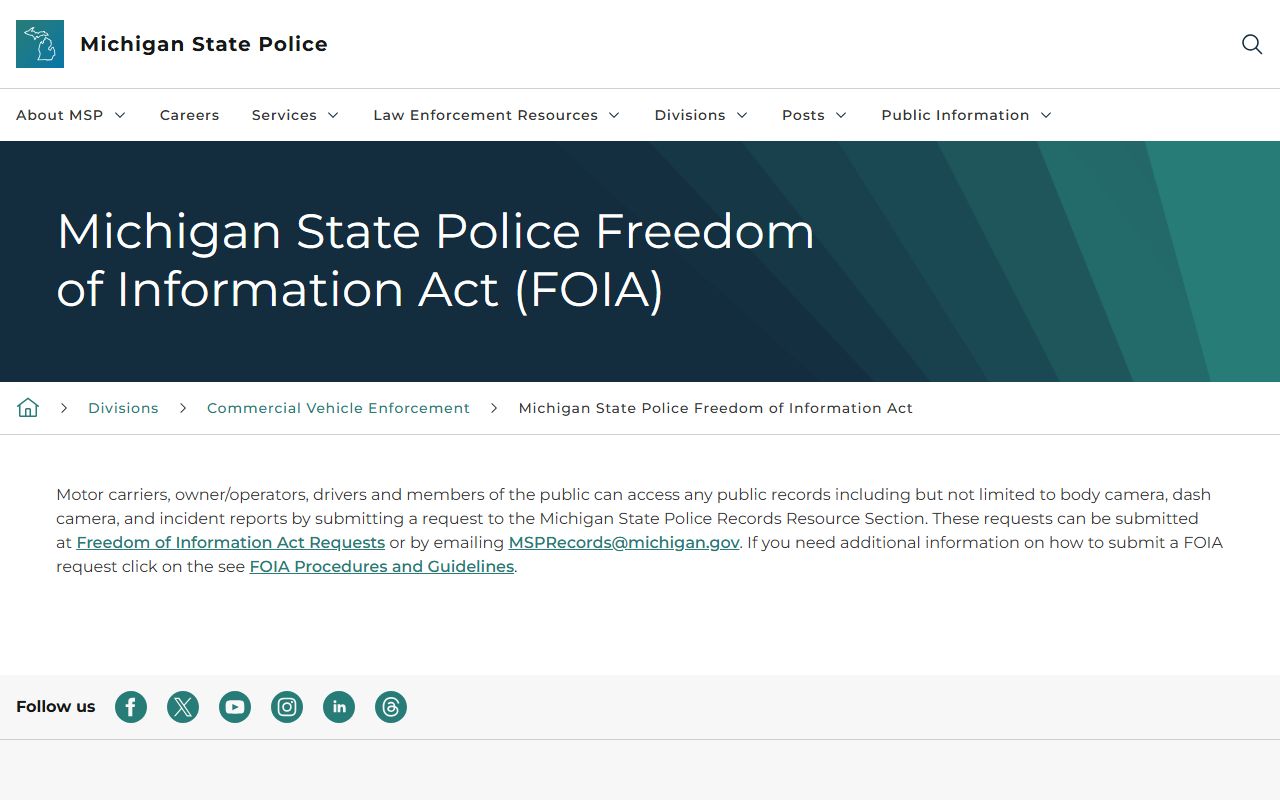
Fees under Michigan FOIA are based on actual cost. Most agencies charge $0.10 to $1.00 per page for copies. Search and review time can also be charged, though many agencies waive small fees. The Michigan State Police FOIA unit accepts requests by email at MSPRecords@michigan.gov. You can ask for incident reports, traffic crash reports, and arrest-related documents from any MSP post.
For city and county law enforcement records, submit your FOIA request directly to the police department or sheriff's office that handled the case. Many agencies now accept requests online through platforms like NextRequest. Local court records, including case files and judgments, are available through the clerk's office at the district or circuit court where the case was filed.
Michigan DUI Records and Driving Consequences
OWI convictions stay on the Michigan driving record permanently. The Secretary of State tracks all license actions tied to OWI charges, and these show up whenever anyone requests a driving record. A first OWI conviction results in a suspension of up to 180 days. After 30 days, a restricted license may be available. A Super Drunk conviction brings a suspension of up to 1 year, with restricted driving possible after 45 days if the driver installs an ignition interlock device. You can request a Michigan driving record through the Secretary of State's office online, in person, or by mail.
A second OWI conviction within 7 years leads to lifetime license revocation. A third offense, regardless of when prior convictions occurred, also results in lifetime revocation with a minimum of 5 years before a hearing can be requested. Getting a license back after revocation is not automatic. The driver must show proof of sobriety under what the Secretary of State calls the clear and convincing evidence standard under Rule 13. Road to Restoration clinics are free events held across Michigan to help people navigate the license reinstatement process.
Michigan also charges Driver Responsibility Fees on top of court fines. Anyone convicted of drunk driving pays $1,000 per year for two consecutive years. That totals $2,000. This fee goes to the Secretary of State and is separate from any court-ordered fines or probation costs. The implied consent law at MCL 257.625c requires all Michigan drivers to submit to chemical testing when stopped. Refusing a test triggers an automatic 1-year license suspension for a first refusal, and 2 years for a second refusal within 7 years.
Note: All OWI convictions in Michigan are permanent on both the criminal history and driving record. They do not age off after a set number of years the way they do in some other states.
Michigan DUI Expungement and Clean Slate
Michigan's Clean Slate legislation allows some OWI convictions to be expunged from the criminal record under certain conditions. First-time OWI offenders may be eligible to apply for expungement after a 5-year waiting period. The expungement removes the conviction from the public criminal history maintained by the Michigan State Police. If granted, the record would no longer appear in ICHAT searches.
There is an important limit to know. Expungement does not affect the Secretary of State's driving record. The OWI conviction stays on your driving record permanently even after a criminal expungement. This means your insurance company and anyone who pulls a driving record report will still see it. The Michigan State Police Criminal History Records page has more on how criminal record requests work after expungement. The Michigan Legislature website at legislature.mi.gov has the full text of the Clean Slate statutes for people who want to read the law directly.
Felony OWI convictions, including third offense and OWI causing death or serious injury, are generally not eligible for expungement. If you are unsure about your eligibility, contact a licensed Michigan attorney for guidance. Legal aid organizations in many Michigan counties offer free or low-cost help with expungement questions.
Browse Michigan DUI Records by County
Each of Michigan's 83 counties handles OWI cases at the local level. District Courts take misdemeanor OWI charges. Circuit Courts handle felony OWI cases. Pick a county below to find court contact info, search tools, and record access resources for that area.
DUI Records in Major Michigan Cities
Residents of larger Michigan cities have DUI cases heard at the district court covering their area. Pick a city to find local court contact info and resources for accessing OWI records in that location.